Academic freedom sounds great until you realize you’re responsible for your own deadlines, your own teamwork, and your own sanity. In its first year at Rockville, AP Seminar has pushed students to a new world of research and multimedia performance.
A Brief Overview:
AP Seminar is a course focused on mastery of skills over content. Instead of the entire AP score being based on one exam in May, College Board splits the AP Seminar assessment into two performance tasks during the school year and one end-of-course exam in May. Throughout the year, students formulate research questions, evaluate peer-reviewed sources, write research papers, and deliver team and individual presentations.
According to Megan Harowitz, an AP Seminar teacher at Rockville, the structure of AP Seminar mirrors higher education more accurately than other standardized tests.
“I think [having] the required assignments throughout the year…it actually makes AP Seminar more aligned with and similar to real college courses,” Harowitz said. “In a lot of college courses, you have major assignments along the way, and then you might have a final exam at the end.”
Evaluation throughout the year means students are required to have sustained effort and prioritize long-term management skills over short-term studying. This heightens the importance of certain skills and encourages students to develop autonomy.
“The research is really collegiate-level, so students are reading peer-reviewed journal articles… and this class is really about, okay, can you set target goals for yourself? Can you work on a project over a long period of time?” said Harowitz.
What Students Say:
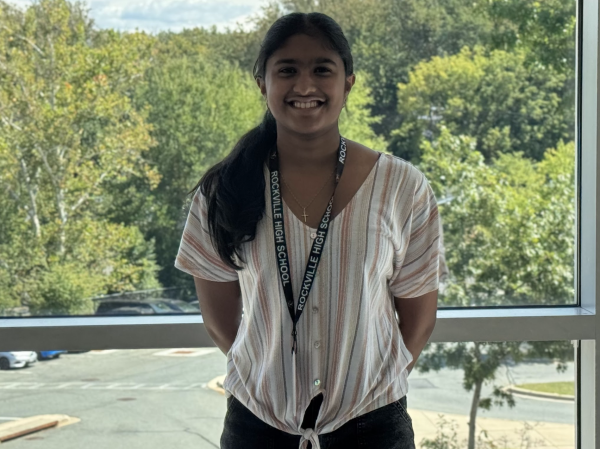
The first batch of AP Seminar students noted the advantages and disadvantages of the class. As far as advantages, students noted an increase in confidence in their communication skills. Sophomore Shilon Debesay found the public speaking components very valuable.
“I liked how it taught me to prepare for presentations and not be nervous about that,” Debesay said.
Sophomore Sanika Bhor highlighted the growth in her analytical skills through the curriculum.
“I like [that it] teaches me to research and kind of develops my writing skills,” Bhor said.
However, developing these collegiate skills wasn’t easy, and the freedom of self-paced work was a double-edged sword. The students agreed that the pressure the course brings can be intense.
“I would definitely say that [the] stress was something,” Debesay said.
Bhor agreed, adding, “Also, if you procrastinate, it’s really hard to catch up.”
Writing the 1200 and 2000-word research papers while simultaneously preparing for long presentations is a large time commitment. This makes time management a crucial skill.
Advice for Next Year:
As Rockville prepares for its second year offering, both faculty and students have some advice for incoming classes. Students are urged not to procrastinate and to stay ahead of deadlines, which includes conducting research and finding sources at the very beginning rather than rushing essays at the last minute. Additionally, AP Seminar teachers plan to educate students on technical skills at the beginning of the year, advising students to learn fundamental formatting and citation skills so they become second nature.
Final Comments:
Overall, despite the rigorous deadlines, AP Seminar can be a beneficial class for students who enjoy writing research papers and giving presentations. The collaborative nature of the performance tasks also creates a sense of academic partnership.
“It does help with working together as a team,” Debesay said. “And I will recommend people taking AP Seminar”.
However, it is important to consider whether the long-term benefits and growth from the class are worth giving up some free time that might be otherwise spent on other activities. The class requires dedication and commitment. Before registering, decide whether you are willing to put in the work and take on the stress that comes with taking this college-level class.
“The class at times can be a lot of work, but I also think that students are proud of the growth that they demonstrate,” Harowitz said. “Knowing that they have the ability and the skill set to write major papers in research… that’s a good thing”.