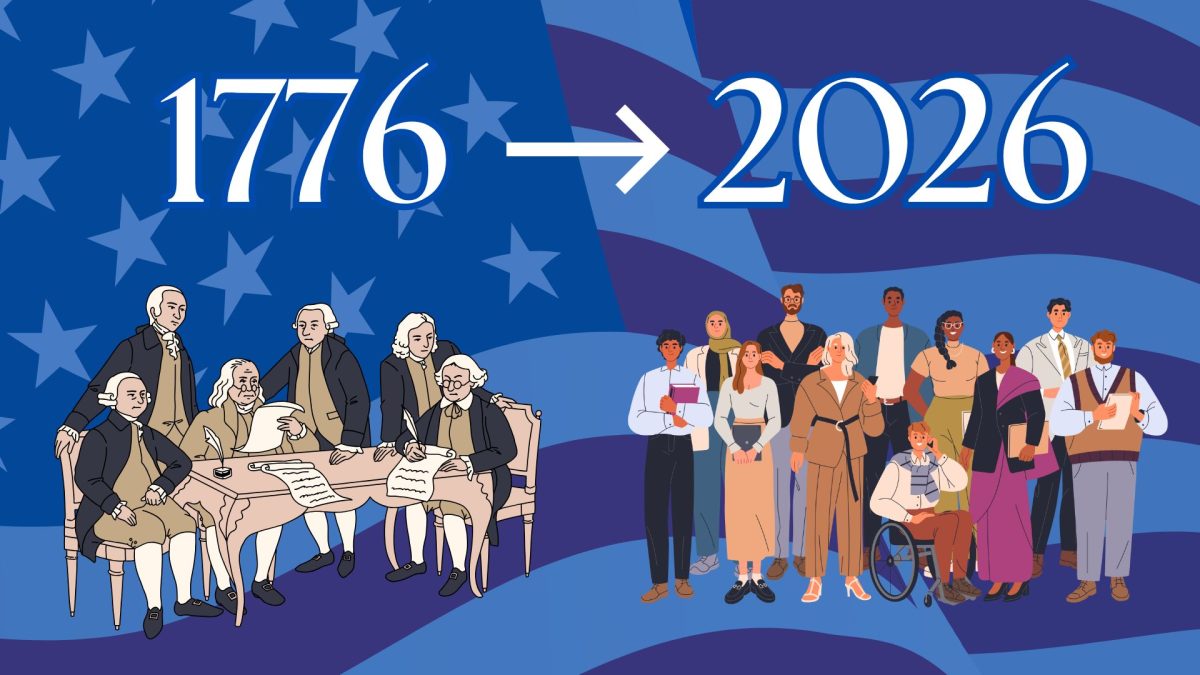
When the Founding Fathers declared that “all men are created equal,” they established a revolutionary principle that endures centuries later. Yet, the reality of the American Revolution was far more limited than the words of the Founding Fathers suggested. The “we” of 1776 America referred to a small, exclusive group of property-owning white men.
Then, 85 years later came the Civil War and the 13th, 14th, and 15th Amendments, expanding the small exclusive group of property-owning white men to a slightly larger group through the abolition of slavery, the right to equal protection for anyone born in the United States, and the right to vote for African American men. Women didn’t get the right to vote until 1920 through the Women’s Suffrage Movement. Later came the Civil Rights Movement in the 1950s and 1960s, which ended legal segregation and led to increased African American representation.
But did the core identity of the United States actually transform? Marilyn Parr, a former archivist at the Library of Congress, believes that the changes were not actually that drastic.
“When you read the documentation, you’ll find that what we think of their opinions now are not as clear-cut as we believe that they are…we like to think that our civilization, or certainly American culture, has evolved and changed. And in some ways it has. But in other ways, perhaps people are still people. That’s pretty simplistic,” said Parr.
The public often does not see these original opinions because they were not published. Thomas Jefferson’s original draft of the Declaration of Independence, for example, included an anti-slavery passage, accusing the King of “violating [human nature’s] most sacred rights of life and liberty.” The passage was taken out, leaving the promise of equality as a rough draft that America would spend the next 250 years trying to finish.
We’ve now established America’s evolution from that small group of white men to what is now a melting pot of different cultures. But how did the small group of rebels become such a big presence in the world? The shift from isolationism to a global industry and military machine was fueled by 20th-century imperialism and the economic strength of the United States. By the mid-20th-century, the US was the “Leader of the Free World,” but this global role influenced how Americans viewed themselves.
For veterans like Bill Lumpkin, the call to serve was rooted in a sense of duty ingrained from childhood.
“I enlisted in the army because it was the right thing to do at the time,” Lumpkin said.
According to Lumpkin, there was a high morale among American troops in Vietnam at the time. However, the war became a turning point where American power was questioned by its own citizens. As the political environment of the country changed in the late 1960s, Lumpkin found himself with a difficult decision to make.
“So I had a choice. I was going to go back [to Vietnam] because I felt comfortable there doing what I had to do. But instead, I joined the police department. So I stayed in the police department, where I could serve my state, county, and country that way instead of going back to Vietnam. And that’s what I did,” Lumpkin said.
He believes that despite the past distrust of the American government, the country in 2026 has returned to a “love of country” and patriotism, in addition to a renewed respect for the military.
Today, the US has a standing as a global titan, but it remains a nation defined by internal division. For Liyanga de Silva, a press secretary in communications, the global image of America is often an illusion that ignores the harsh realities of those working in the service industry or manual labor.
“At a bare minimum, the American Dream represents the promise of safety and freedom,” de Silva says. She points out that the “American Dream” was likely never originally intended to include people of color or immigrants.
Under the current Trump Administration, de Silva observes that “American” has become a debated word. While the US may function as a superpower abroad, its current government often wreaks havoc and harm internationally and within the country. When looking at the polarization of 2026, de Silva sees echoes of the 1860s.
“Our division during the Civil War was a result of socio-economic systems of inequality, and that’s the same thing driving our divisions today,” de Silva says.
As the United States celebrates its 250th anniversary this year, the “melting pot” remains the most defining feature of our country. While the Founders may never have imagined this country as it exists today, we can still hope that 2026 will bring America a new identity, perhaps one that creates opportunities to do something better than the original promise of 1776.