While municipal elections may not be something the average high schooler pays any mind to, the 2025 NYC Mayoral Election caught the attention of millions this fall. Despite the 228 miles between New York City and Rockville, MD, candidates’ digital campaigning likely ended up on many RHS students’ social media feeds.
Why did this election have such a far-reaching impact on people who weren’t even affected by the results? It’s all due to the digital campaigning done by NYC mayor-elect Zohran Mamdani.
As the first major election cycle after the 2024 Presidential Election, the NYC Mayoral race made headlines as Zohran Mamdani, self-proclaimed Democratic Socialist, pulled ahead of Republican Curtis Sliwa and Independent (former Democrat) Andrew Cuomo. Mamdani received 50.4% of the votes, and voter turnout reached approximately 2 million, the highest recorded in NYC since 1969.
Mamdani’s unexpected victory serves as a model for future political campaigns, proving that many aspects of campaigning should be taken more seriously: that candidates should not shy away from non-centrist ideology, and that social media has the incredible potential to maximize voter turnout and support.
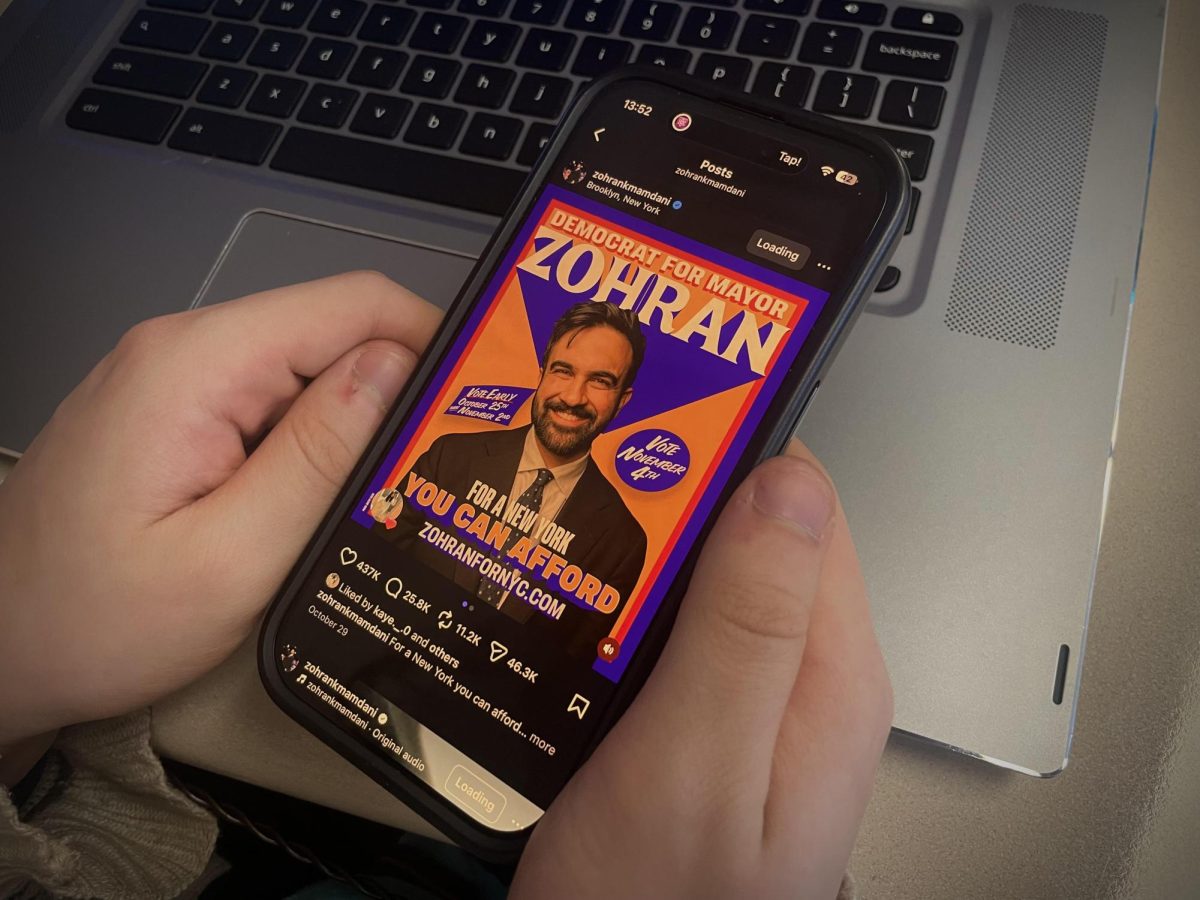
The first success of Mamdani’s digital campaign lies in the visual strategy and striking marketing design. The graphics leaned away from the patriotic red, white, and blue adopted by most candidates. Instead, the bright blues, oranges, and yellows of Mamdani’s campaign purposefully mimicked the classic palette of NYC taxicabs, subway tiles, and bodega awnings. The bracketed serif typography and bold outlines allowed the slogans and iconography to convey the energy and expressiveness of the campaign, stylized in a simplistic but unique way. Visual interest is crucial in immediately drawing people to follow a campaign, allowing the candidate to subsequently lead them to support their platform.
While Mamdani’s graphic design caught the attention of millions across the internet, he also made a point to connect with constituents in a manner mainly unexplored by politicians—by way of social media influencers. Mamdani used social media to document his interactions with people from all walks of life, making appearances in popular TikTok talk shows, Twitch streams, and other short-form media. New York content creators, many of whom don’t normally post about politics, jumped at the opportunity to advocate for Mamdani’s platform.
Not only did these influencers post videos featuring Mamdani and his views, they also successfully rallied their fanbases to support Mamdani’s campaign. GenZ and Millennial voter registration and turnout in NYC were therefore at unprecedented levels, and the results of that turnout arguably ended in Mamdani’s favor—78% of voters ages 18-29 cast their votes for Mamdani, according to CNN exit polls. The campaign’s focus on younger voters and other underrepresented constituents was largely thanks to the use of digital campaigning, and certainly had a positive impact on voter turnout.
“[Mamdani] was really able to specifically target different communities in very personalized ways, maximizing a very human connection in a very thorough, scientific way with a lot of media strategy testing,” psychologist and author Dr. Andrea Bonior said. “He had a real-time feedback loop, where his team would put stuff out there and see what maximized engagement, and then they would double down on that…using those algorithms to connect with people who I think were hungry for connection and ignored by traditional political campaigns.”
Indeed, Mamdani’s campaign linked the younger generations to politics using unconventional, engaging campaign methods. Using social media as a means of connection, Mamdani’s campaign organized interactive social events such as a citywide scavenger hunt in August 2025. Inspired by the campaign’s digital call to action, supporters of Mamdani created their own merch-making and canvassing events, using Instagram and TikTok to rally fellow supporters.
Digital campaigning is not a new idea, of course, but few candidates have achieved the same level of success that Mamdani accomplished. During the 2024 Presidential Election, Kamala Harris leaned into the popularity of the Charli XCX album “Brat,” receiving an endorsement from Charli XCX herself and reposting memes quoting a viral line about a coconut tree from one of Harris’s earlier speeches.
While this campaign strategy successfully appealed to the attention of younger voters, it did not effectively communicate Harris’s political views. Meanwhile, Mamdani hopped onto multiple social media trends while continuing to promote his stance on citywide, nationwide, and international topics, including his key policy initiative aiming to make New York more affordable for residents.
The lack of success from the Harris social media campaign, in comparison to Mamdani’s, lay in the fact that Harris didn’t connect her viral moments to her campaign. Meanwhile, Mamdani’s posts meaningfully revealed his political stance and aligned with him as a candidate. Every video in which Mamdani guest-starred featured his viewpoint on a major issue, without sounding preachy or too scripted. Because Mamdani took each opportunity to argue for his stance on a variety of issues, viewers not only gained an appreciation for his charisma, they also learned about his candidacy and were more likely to support his political goals.
The outcome of this election should certainly impact how political candidates campaign in the future and in larger-scale races. But should digital campaigning and activism take precedent over real-life campaigning? Is one more effective than the other? Because of the internet’s tendency toward misinformation, Bonior argues that campaigning shouldn’t solely focus on online presence.
“The psychological research is very clear: misinformation tends to spread more quickly and more widely than more boring, truefaced things, if it is emotionally manipulative,” said Bonior. “So my concern with social media’s reach is that it is very influential in a way that it shouldn’t be, because the information is oversimplified or distorted or false. And I think that’s where we need to be concerned with undermining democracy.”
Despite possible misuse of social media as a campaigning tool, digital campaigning should certainly be taken more seriously than before after the success of Mamdani’s mayoral campaign.
“I’m already seeing a lot of people looking at the results and being surprised by them and saying ‘What can this teach us about how the media landscape is changing for voters?’” Bonior said.